


Your Guide to the First Night of Hanukkah Blessings
There's a special kind of magic in the air on the first night of Hanukkah. It feels different from the other nights, and for good reason—we say three blessings instead of the usual two. That third blessing, the beautiful Shehecheyanu, is all about gratitude, a heartfelt thank you for letting us reach this incredible moment once again. It truly makes the first lighting a profound way to kick off the Festival of Lights.
The Three Blessings for a Joyful First Night
Ready to fill your home with light and tradition? This is your complete guide to the three blessings that make the first night of Hanukkah so memorable. Whether you're a seasoned pro or lighting the menorah for the first time, you'll find everything you need right here for a confident and meaningful ceremony.
Below, I’ve laid out the full Hebrew text, an easy-to-follow transliteration for pronunciation, and a clear English translation for each prayer. Let's get started!
Blessing 1: The Commandment to Kindle
This first blessing is our connection to the mitzvah itself—the sacred commandment to light the Hanukkah candles. As we say these words, we join a chain of tradition stretching back thousands of years, connecting us with every generation that has performed this same beautiful act.
- Hebrew: בָּרוּךְ אַתָּה אֲדֹנָי אֱלֹהֵינוּ מֶלֶךְ הָעוֹלָם אֲשֶר קִדְּשָׁנוּ בְּמִצְוֹתָיו וְצִוָּנוּ לְהַדְלִיק נֵר חֲנֻכָּה
- Transliteration: Baruch atah Adonai, Eloheinu Melech ha'olam, asher kid'shanu b'mitzvotav v'tzivanu l'hadlik ner shel Hanukkah.
- English: Blessed are You, Lord our G-d, King of the universe, who has sanctified us with His commandments, and commanded us to kindle the Hanukkah light.
Blessing 2: The Miracles of Our Ancestors
Next, we shift our focus from the commandment to the reason for it. This blessing is all about remembering the incredible miracles God performed for our ancestors "in those days, at this time." It powerfully links the tiny flame in our home to the epic story of resilience, faith, and the miracle of the oil.
- Hebrew: בָּרוּךְ אַתָּה אֲדֹנָי אֱלֹהֵינוּ מֶלֶךְ הָעוֹלָם שֶׁעָשָׂה נִסִּים לַאֲבוֹתֵינוּ בַּיָּמִים הָהֵם בִּזְּמַן הַזֶּה
- Transliteration: Baruch atah Adonai, Eloheinu Melech ha'olam, she'asa nisim la'avoteinu bayamim haheim baz'man hazeh.
- English: Blessed are You, Lord our G-d, King of the universe, who performed miracles for our forefathers in those days, at this time.
Blessing 3: The Shehecheyanu: Gratitude for Today
And now for the one that makes the first night truly unique! The Shehecheyanu is a powerful prayer of pure gratitude. We recite it for special occasions and firsts—the first time we do something in a new year, the first taste of a new fruit, and the first night of a festival. It’s our way of saying, "Thank you for keeping us alive, for sustaining us, and for bringing us to this very moment."
The first night of Hanukkah blessings is defined by saying these three traditional blessings, a practice that sets it apart from the rest of the holiday. You can dive deeper into these beautiful traditions at Sephardic University.
- Hebrew: בָּרוּךְ אַתָּה אֲדֹנָי אֱלֹהֵינוּ מֶלֶךְ הָעוֹלָם שֶׁהֶחֱיָנוּ וְקִיְּמָנוּ וְהִגִּיעָנוּ לִזְּמַן הַזֶּה
- Transliteration: Baruch atah Adonai, Eloheinu Melech ha'olam, shehecheyanu v'kiy'manu v'higianu laz'man hazeh.
- English: Blessed are You, Lord our G-d, King of the universe, who has granted us life, sustained us, and enabled us to reach this occasion.
To help you keep everything straight, here's a handy table summarizing the blessings for the first night.
Quick Guide to the First Night Blessings
Your quick reference for the three blessings, their core meaning, and when to recite them for a perfect start to Hanukkah.
| Blessing Number | Common Name | Core Meaning | When It's Recited |
|---|---|---|---|
| 1 | L'hadlik Ner | Acknowledges the commandment to light the candles. | Every night of Hanukkah |
| 2 | She'asa Nisim | Thanks God for the miracles of the Hanukkah story. | Every night of Hanukkah |
| 3 | Shehecheyanu | Expresses gratitude for reaching this moment. | Only on the first night of Hanukkah (or first time lighting) |
This table is a great little cheat sheet to have nearby, especially if you have little ones helping you lead the blessings
The Miracle Behind the Festival of Lights
So, what’s the big deal with these blessings and lighting the menorah? Well, behind every meaningful ritual is an incredible story, and Hanukkah’s is a real-life epic of courage, faith, and freedom. When you kindle that first flame, you’re not just lighting a candle—you're connecting to a powerful moment in Jewish history and turning a simple act into a shining beacon of hope.
To really get why the first night of Hanukkah blessings feel so special, let's hop in a time machine. We're going back over 2,000 years to when the Syrian-Greeks ruled over the land of Israel. Their king, Antiochus IV, was on a mission to stamp out Jewish identity. He outlawed Jewish practices and, in a final act of desecration, defiled the Holy Temple in Jerusalem.
But a small band of Jewish freedom fighters, who we know as the Maccabees, refused to let their heritage be extinguished. Led by the legendary Judah Maccabee, they rose up against a massive, well-equipped army. They weren't just fighting for their lives; they were fighting for the soul of their people. And against all odds, they won.
Rededicating the Temple and Witnessing a Miracle
The first thing they did after reclaiming Jerusalem was to purify and rededicate the Holy Temple. They wanted to relight the golden menorah, a constant symbol of God's presence. But when they searched for the special, sanctified olive oil required, they found only one tiny jug—just enough to last for a single day.
And then, the miracle happened. That small amount of oil burned brightly for eight full days, exactly the time needed to press and prepare a new supply. This incredible event became a timeless lesson: even the smallest flicker of light can push back the greatest darkness.
This whole story, the Maccabean revolt around 165 BCE and the rededication of the Second Temple, is the bedrock of the festival. The eight-day celebration we know today was born from that miracle of the oil, establishing the tradition of lighting one more candle each night. For a deeper dive into the history, Britannica has a fantastic overview.
A Light That Only Grows Brighter
This brings us to a famous and beautiful debate between two of the greatest Jewish sages, Hillel and Shammai. They disagreed on the how of lighting the menorah.
Shammai argued we should start with eight candles and remove one each night. Hillel, on the other hand, championed the idea of starting with one candle and adding a new one every night. His reasoning was simple but profound: in matters of holiness, we should always be increasing.
Guess who won the debate? We follow Hillel's wisdom to this day.
By starting with a single flame and building up to a blaze of eight, our menorah becomes a powerful visual for life. It teaches us that hope, faith, and goodness should always be on the rise, growing brighter and stronger day by day. This perfectly captures the spirit of the first night—it's not just a beginning, but the start of something beautiful that will grow and expand. Each new flame joins the others, just as each generation adds its own light to the ongoing story of the Jewish people.
Your Step-by-Step Menorah Lighting Guide
Alright, let's bring the beautiful glow of Hanukkah into your home! Lighting the menorah is one of the most heartwarming parts of the holiday, and I'll walk you through every step for the very first night. Think of this as your friendly guide to making the ceremony joyful, meaningful, and totally stress-free.
The whole ritual is wrapped up in an incredible story of courage, faith, and miracles.
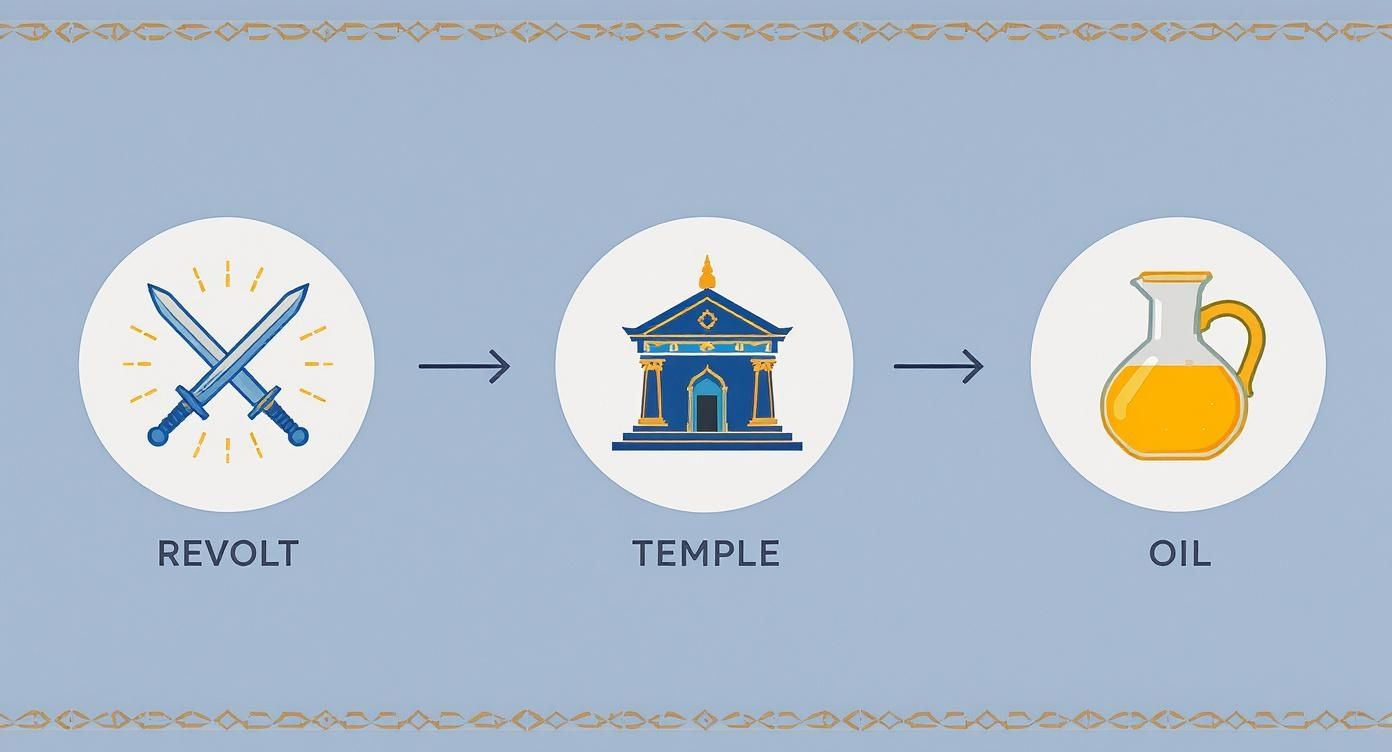
This powerful journey—from revolt to rededication to miracle—is the very heart of why we gather to light these candles each year. So, let’s get ready to bring that story to life!
Prepping Your Menorah
First things first, find the perfect spot for your menorah. Tradition tells us to place it in a windowsill or by a doorway, somewhere it can shine brightly for all to see. The whole idea is to publicize the miracle (pirsumei nisa), sharing its light and message with the world.
If that's not possible or safe in your home, a central table where the family can gather is a fantastic choice. Safety always comes first!
Now, let's set the candles. For the first night, you'll need just two:
- The Shamash: This is your "helper" or "attendant" candle. It gets its own special spot, usually set a little higher or off to the side.
- The First Night Candle: Pop this candle into the holder on the far right side of the menorah (as you're facing it).
The Lighting Ceremony, Step by Step
With your menorah ready and your family gathered around, it's time for the magic to begin. The best time to light is right after sundown, as the first few stars start twinkling in the sky.
- Light the Shamash: Go ahead and light the Shamash candle first. Don't light any of the others just yet! Keep the lit Shamash in your hand.
- Say the Blessings: While holding the flame, it’s time to recite the first night of Hanukkah blessings. This night is extra special because we say all three: the blessing for the commandment, the one for the miracles, and the beautiful Shehecheyanu.
- Kindle the First Flame: Right after finishing all three blessings, use the flame from your Shamash to light the first night's candle—the one on the far right.
- Place the Shamash: Once that first candle is glowing, put the Shamash back in its designated spot on the menorah. And just like that, you have two beautiful lights!
The order is key here: We say the blessings first, then we light. It’s a powerful lesson, teaching us to fill the moment with intention and gratitude before we even act. Our words bring meaning to the flame before it even touches the wick.
After the candles are lit, let them burn for at least 30 minutes after nightfall. This is sacred time. Resist the urge to run off and do chores. Instead, linger by the menorah's glow. Sing songs, play a game of dreidel, or share the story of the Maccabees. It's the perfect chance for the family to connect and bask in the warmth and history of the Festival of Lights.
How Families Make Hanukkah Their Own
While the beautiful first night of Hanukkah blessings bring Jewish families together across the globe, what comes next is a gorgeous tapestry of family customs. Jewish culture has never been a one-size-fits-all deal; it’s a living, breathing collection of rich histories. This diversity really sparkles during Hanukkah, especially when you compare the traditions of Ashkenazi and Sephardi communities.
Think of it like two incredible bakers using the same family recipe for a cake. The essential ingredients are there for both, but one adds a pinch of cinnamon and the other a splash of vanilla. Both cakes are delicious, but each has its own unique, wonderful flavor.
Ashkenazi and Sephardi Traditions
For many Ashkenazi Jews, whose families come from Eastern and Central Europe, the routine is often to light the Shamash (the "helper" candle) first. Then, you recite the blessings and use the Shamash to light the other candles. Right after, you might hear the whole family break into a rousing chorus of "Ma'oz Tzur" ("Rock of Ages").
On the other hand, Sephardi Jews—with roots tracing back to Spain, Portugal, North Africa, and the Middle East—often do things in a slightly different order. It's common in Sephardi homes to say the blessings before lighting the Shamash, and then using it to kindle the other lights. Their post-lighting celebration might be filled with beautiful Ladino songs or Hebrew poems called piyyutim, like "Mizmor Shir Chanukat HaBayit."
The real magic of these variations is the story they tell. Every little difference—the order of the blessings, the melody of a song—is a glowing thread connecting a family to their unique past, keeping the memory of their ancestors alive in the light of the menorah.
Neither way is more "right" than the other! They are simply different, beautiful paths to the same joyful celebration of miracles and light.
Modern Twists on an Ancient Holiday
Today, families are adding their own creative flair to this ancient tradition, making it feel personal and deeply meaningful. The core mitzvah of lighting the candles is the anchor, but the celebration around it is wonderfully flexible.
Here are a few ways families are making it their own:
- Giving Each Night a Theme: Some families create a special focus for each of the eight nights. Maybe one is "Tzedakah (Charity) Night" for donating to a cause, and another is "Craft Night" for getting creative with Hanukkah art.
- Sharing the Blessings: Instead of having one person lead, each family member can take a turn reciting one of the blessings. This small change makes everyone feel more involved and connected to the ritual.
- A World of Flavors: Latkes and sufganiyot are the undisputed champions of Hanukkah food, but some families are exploring treats from other cultures, like delicious Sephardic bimuelos (heavenly little fried dough puffs).
Of course, once the candles are glowing, the fun is just getting started! For a classic game that gets everyone laughing, check out our guide on how to play the dreidel game. By mixing these new ideas with treasured old customs, we ensure Hanukkah remains a vibrant, cherished holiday for generations to come.
Making the Hanukkah Blessings Magical for Kids
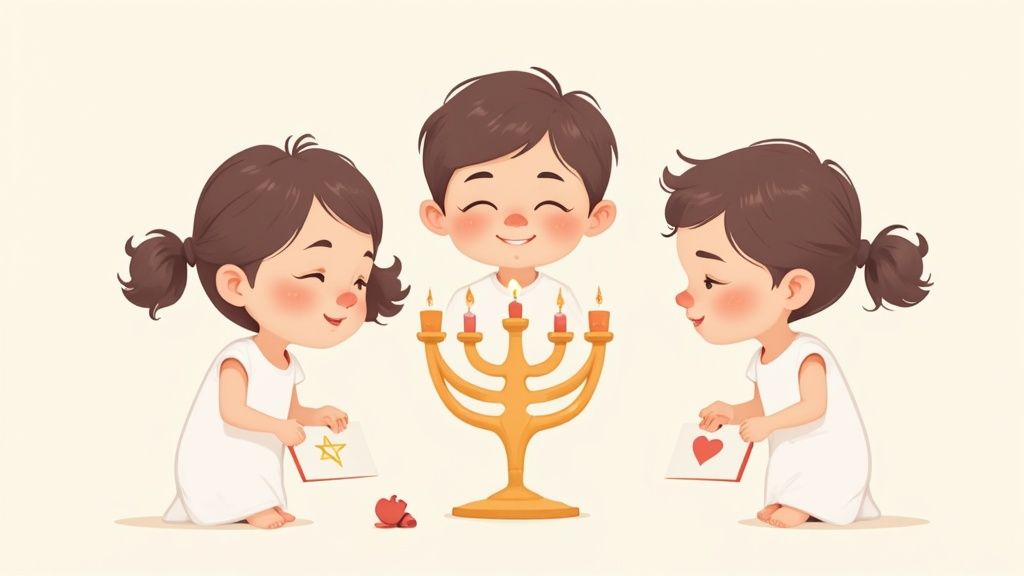
There's nothing quite like watching the glow of the menorah reflected in a child's eyes. It's pure magic. As parents, we get to transform this ancient ritual into a vibrant, living memory they'll hold onto forever. And the first night of Hanukkah blessings is the perfect starting point to make the tradition fun, accessible, and deeply personal for even your littlest ones.
The trick is to go beyond just reciting the words and invite your kids to become joyful, active participants. Think of the blessings as a beautiful song—you don't just want them to hear it; you want them to feel the rhythm and sing along! With a little creativity and a lot of enthusiasm, we can spark a lifelong love for the Festival of Lights.
Engaging Little Ones with Sight and Sound
For toddlers and preschoolers, the world is a hands-on, sensory playground. Long Hebrew words might fly right over their heads, but simple, repetitive actions can make the blessings feel like the best kind of game.
- Create Hand Motions: Match a simple gesture to a key word in each blessing. For the first one (lehadlik ner), pretend to strike a match and light a candle. For the second (she'asa nisim), wiggle your fingers like sparkles to show the miracles. And for the Shehecheyanu, wrap your arms around yourself in a big hug to celebrate being together.
- Sing It Loud: Most kids learn way faster through music. Find a simple, catchy tune for the blessings and sing them with all your might every single night. Repetition is your best friend here!
- Craft DIY Blessing Cards: Break out the construction paper, crayons, and glitter! Make visual aids for each blessing with simple drawings—a candle, a Star of David, a smiling family. Let your child decorate them and hold up the right card as you say each prayer.
These little interactive steps completely change the game, turning the candle-lighting from something they watch into something they do.
The goal isn't perfect pronunciation right away; it's about creating happy, warm memories. When kids connect the blessings with joy, creativity, and family time, they're building the foundation for a meaningful Jewish identity.
Empowering Older Kids with Deeper Meaning
As children get older, you can start exploring the incredible stories and values tucked inside the blessings. This is your chance to connect the ancient words to their world today, making the tradition feel relevant and powerful.
One of the best ways to do this is through storytelling. Reading together about the Maccabees and the miracle of the oil brings the blessings to life. For instance, fantastic children's picture books can make ancient history feel like an edge-of-your-seat adventure.
To give your kids a real sense of ownership, try creating special jobs for each night. This isn't just about getting things done; it’s about making them feel important and needed. Below are some ideas to get you started, but feel free to invent your own!
Engaging Hanukkah Activities by Age Group
A parent's guide to involving children of all ages in the Hanukkah celebration, making it fun and educational for everyone.
| Age Group | Activity Idea | Learning Goal |
|---|---|---|
| Toddlers (1-3) | Blessing Copycat: Sing a short, simple part of a blessing (like "Baruch Atah") and have them sing it back. Use hand motions! | Familiarity with the sounds and rhythms of the blessings. Associates prayers with fun and family. |
| Preschoolers (3-5) | Menorah Artist: Use play-doh, legos, or paint to create their own menorah. Count the candle holders together. | Reinforces the number of nights (8) and the concept of adding a candle each evening. Develops fine motor skills. |
| Early Elementary (6-8) | Storyteller's Apprentice: Read a Hanukkah storybook together and have them retell the story in their own words before lighting the candles. | Deepens understanding of the Hanukkah narrative (the miracle, the fight for freedom) and boosts comprehension skills. |
| Older Elementary (9-12) | Family Historian: Interview a grandparent or older relative about their Hanukkah memories. What traditions did they have? | Connects them to their family's personal history and the continuity of Jewish tradition across generations. |
By giving each child a meaningful role, you’re sending a powerful message: their contribution is essential to our family's celebration. You're empowering them to not just witness tradition, but to become the keepers of the flame for the next generation.
Answering Your First Night Questions
Getting ready to light the menorah for the first time is so exciting, but it’s totally normal for a few questions to pop into your head. This tradition is packed with so much history and meaning, and wanting to get it “just right” is a beautiful thing! We've put together answers to the most common questions about the first night of Hanukkah blessings so you can feel confident and focus on the joy of the moment.
Let’s get into the nitty-gritty details that can sometimes feel a little confusing.
What Happens if I Forget the Shehecheyanu Blessing?
First off, take a deep breath. It happens! The most important thing is your intention and the love you bring to the moment. If you realize you forgot to say the special Shehecheyanu blessing while the first-night candles are still glowing, you can absolutely say it right then and there.
But what if you don't remember until the second or even third night? No problem at all. The whole point of this beautiful blessing is to thank God for bringing us to this special time of year. It’s much better to say it late than to skip it. Just recite it the next time you gather to light your menorah.
What Is the Correct Order for the Blessings?
Great question! The order is actually designed to build a wonderful sense of holiness and anticipation. For that magical first night, the flow is really simple.
- First, light your Shamash—the helper candle—and hold it.
- Before lighting any of the other candles, you’ll say all three of the first-night blessings.
- Start with the blessing for the commandment to light the candle (…lehadlik ner).
- Follow that with the blessing for the miracles (…she’asa nisim).
- And finally, wrap it up with the special Shehecheyanu blessing.
Once all three blessings are said, you can use the Shamash to light the very first candle on the far right. Easy as that!
There's a beautiful lesson in this order: We fill the moment with holiness and gratitude with our words before we do the action. The blessings set the stage for the miracle we're about to create with the light.
Do I Say the Blessings Over an Electric Menorah?
Electric menorahs are fantastic! They’re a wonderful and safe way to share the light of Hanukkah in public spaces like offices or hospitals, or even just as a festive decoration where you can't have an open flame. They do an amazing job of publicizing the miracle!
However, when it comes to fulfilling the actual mitzvah (commandment) of lighting the Hanukkah lights, Jewish law is pretty specific: it requires a real, physical flame from either oil or candles. For that reason, the sacred blessings should only be said when you're about to light a menorah with a genuine flame. Of course, you can absolutely use both to fill your world with even more light!
Where Is the Best Place to Put My Menorah?
The whole spirit behind displaying the menorah is something we call pirsumei nisa—which means publicizing the miracle! To really lean into that idea, the most traditional spot is on a windowsill facing the street. This way, people walking by can see the lights and be reminded of the incredible Hanukkah story.
If a windowsill isn't practical or safe in your home, placing the menorah on a table in a central part of your house is also a perfect option. The main goal is to put it in a safe, visible spot where its beautiful glow can fill your home with warmth and be enjoyed by your whole family. If you have other specific questions about your family's traditions, please don't hesitate to reach out to us through our contact page. We’re always happy to help.
